

Is creativity always a little bit embarrassing?
a trip to latitude & an extract


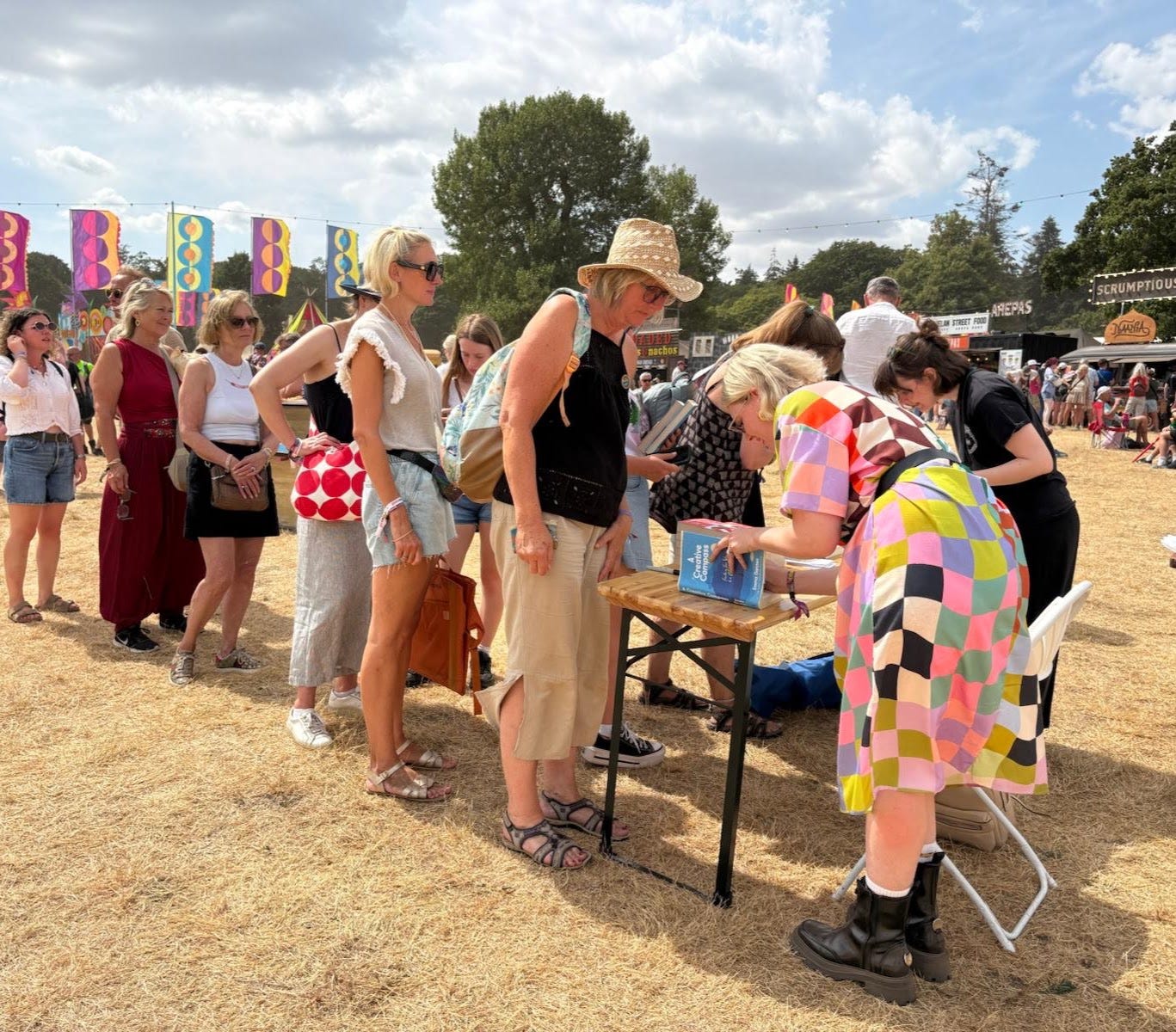
Editor’s Note: This weekend I spoke about my new book at Latitude Festival and stayed at a tranquil hideaway b&b Five Acre Barn in Suffolk, twenty-five minutes drive to the festival. We drove from London and stopped off in Aldeburgh and had a fish pie at The Lighthouse. We checked into the b&b, and enjoyed the little garden out the back of our room, filled with a wild cacophony of sounds, and spotted a grass snake. Breakfast and coffee outside each morning was delicious, greeted by two beautiful dogs.
I was interviewed about my new book in The Listening Post tent, signed lots of copies, and then enjoyed napping under trees, eating festival food, watching live music (psychedelic rock anyone?) and seeing David Byrne perform on the main-stage in the evening which was brilliant. After the festival, spent the day in Walberswick and got the little ferry to Southwold and walked along the beach, explored the pier, dipped into bakeries and bookshops. I do love Suffolk. (More pics here).
Below is an extract from my new book A Creative Compass: Finding Your Way to a Creative Life. I spoke about this topic (creativity being embarrassing!) this weekend at the Festival and it seemed to resonate with people so I wanted to share it here for you—for free! Most of The Hyphen can be accessed via a paid subscription. Enjoy!
Is being creative inherently embarrassing?
by Emma Gannon, from the book A Creative Compass
When I first started publishing my writing online (in my late teens), I would hide it from my friends and family. I started posting fragments of poems and paragraphs to various blogs and social networks, wanting to connect with new people. I didn’t feel embarrassed by the thought of strangers reading it, but I did feel embarrassed by the idea of anyone I knew stumbling across it.
The same thing happened with events. If the auditorium was full of strangers, I felt fine – but if I spotted anyone I knew from my personal life, I would instantly clam up. Many artists and performers I know feel this way. On a big stage they can feel totally at home, sharing freely, yet in a group of only a few people, they can feel nervous and guarded.
My writing voice always felt slightly disembodied from my day-to-day life because my writing life was mostly secret. Many of my online readers knew more about me than some of my family members and friends. In order to break out of my ordinary life and take on a life as a writer, I had to work hard at quietening the inner critic and shedding the heavy feelings of shame and embarrassment: Who was I to be building this online identity? Who was I to attempt being a writer at all?
As Zadie Smith once said, ‘Everybody feels ashamed when they write.’
I often questioned myself: Who am I to share my thoughts so openly? Especially when no one has asked for this? But there was a curious part of me that always wanted to reach more people beyond my day-to-day life and nine-to-five job. I enjoyed connecting with like-minded people I might never meet, travelling through time and space with my words.
And over time, my desire to connect with others grew stronger than my insecurities.
In September 2015, I was in my mid-twenties, living in London and working in one of my first magazine jobs at Condé Nast. I was networking with interesting people as part of the day job and moonlighting as a blogger too. I was invited to read from my teenage diary at a night called Cringe by a lovely volunteer, who I think had originally messaged me on Twitter. I said yes before I could overthink it. It was held in the basement of a pub in London – the Phoenix in Cavendish Square.
The Cringe monthly reading series originated in Brooklyn, New York, created and hosted by Sarah Brown, and was described in a 2017 review as this:
‘Brave souls come forward and read aloud from their teenage diaries, journals, notes, letters, poems, abandoned rock operas, and other general representations of the crushing misery of their humiliating adolescence. It’s better and cheaper than therapy.’
I loved the phrase ‘brave souls’. I felt compelled to say yes, even though I felt terrified.
I would be reading from a diary I had kept ten years earlier – when I was fifteen. A silver diary from WHSmith, thick with additional folded pages glued inside. I wore a light blue blouse and put on some lipstick for extra confidence before making my way there after work.
Back then, I was working at Glamour magazine in the Condé Nast building in Hanover Square. The office was packed with It Girls, all preoccupied with staying fashionable, polished and ahead of the curve – turning up every morning with their giant lattes. Attending fashion weeks wearing the latest designers, with assistants booking lunch spots at expensive restaurants. And here I was, about to bare all about my teenage escapades on stage, wearing a cheap secondhand blouse.
I invited a few friends to Cringe but wanted the whole thing to remain low-key. We all got drinks at the bar, the lovely volunteer introduced everyone and, when it was my turn, I felt the nerves rise in my stomach as the reader before me stepped off stage to loud applause. I stood up there, in the centre of the stage, a microphone in front of my face, and creaked open the pages of my teenage diary.
I read aloud about having a crush on a boy I’d met at my squash lessons at the local sports centre in Exeter – and how terribly bad my flirting was. How I wore a full face of make-up to the sports centre. How the ringtone on my Nokia was incredibly annoying. My ‘comedy bit’ involved trying to impress him with my new sports bag. It got some big laughs, and everyone in the audience was kind and supportive. Cringe, indeed.
I had to remind myself that everyone there had bought a ticket with their hard-earned money. They were seated, they had snacks and drinks, they wanted to hear from us, they wanted us to be there. I realised the audience is, usually, on your side. Later that night, the volunteer emailed me to say she’d loved it and did I want to read on another night, again?
My experience reading my teenage diaries under a spotlight prepped me for what would become my life as a writer. On stage at Cringe, I was in control. I had my material. I pulled out certain sentences and matched them with other paragraphs. The unedited diary was raw, but my performance had been crafted and selected. There were notes in the margins. I decided what I was going to read to the audience and what I would leave out. I didn’t read everything on each page; I carefully chose what was most important, interesting, and entertaining to an audience. I wasn’t divulging information for the sake of it; I was crafting something for consumption.
There is a difference between writing in your journal freely and writing to be read. Journaling is private – like Morning Pages, which are never meant to be read by anyone else. Writing for an audience requires awareness that it will be consumed, potentially shared, and live on – and therefore must be shaped and edited with that in mind.
Here is how this comes back to the creative compass: it felt good.
I wanted to read my work, I wanted to feel a bit scared, on the edge, and I wanted to connect with people. I wanted to experience a room of laughter, the smell of beer, the audience sitting a little too close to each other in a cramped room. I wanted to be there, to participate, to be a part of something. Even though I was nervous, there was a happy, warm feeling in my solar plexus.
Being a writer or artist often means exposing yourself to some level of embarrassment, especially early on. But it is also rewarding: you feel connected to others when you share those parts of yourself. Standing on that stage at Cringe is still how I feel most of the time when I share my written work with the world – even now, on stage at big literary festivals. Perhaps that feeling never truly goes away, and that’s OK. And it always feels worth it on the other side.
Over time, we must learn to stomach the embarrassment and show up anyway. There’s a line commonly associated with Eleanor Roosevelt: ‘No one can make you feel inferior without your consent.’ Feeling a bit embarrassed is a small price to pay for your art being made and shared.
Some days, even now, I think to myself, This writing business is somewhat humiliating. Why do I put myself out there like this?
And yet, I continue. It turns out you can’t die of embarrassment. The good news is you get to make another thing tomorrow. You always get to try again. Embarrassment fades over time. Pride takes its place.
A Creative Compass: Finding Your Way to a Creative Life is out now.
The earlier we realize that embarrassment and creativity go hand-in-hand, the better off we are. I used to plan my writing career like I was gearing up to rob a bank. NO ONE MUST KNOW! Cringe is a great name for those readings. It is the most cringe to share and share and share, but it feels like the end of a sneeze on the other side!
Reading this was a balm. I shared my substack link with basically everyone I know, and even though I'm writing for people beyond just them, it feels extra vulnerable to share about sobriety and motherhood with the people who know me. I appreciate this perspective -- and you're right, it does somehow feel good, even as it feels cringey and embarrassing, too. Thank you, Emma.